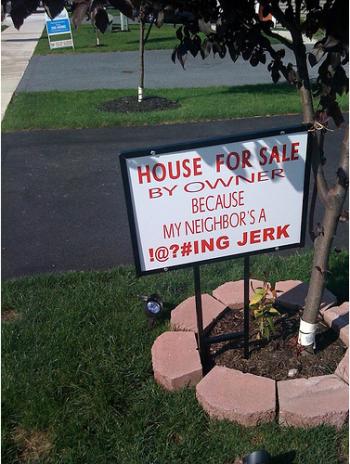
COULD HOMES FOR SALE IN LAS VEGAS HAVE FEATURE FLAWS
There are many generalizations that can be truly instructive for homeowners with Las Vegas homes for sale. The undeniable importance of “location, location, location!” is a good one; de-clutter! as a main order of business is another…as is the wisdom of researching neighborhood comparables. Anybody with homes for sale in Las Vegas can usually visit the National Association of REALTORS® website for useful nuggets of that kind of information. However, one article that appeared there last week seemed to me to be less than real estate gospel—although it was thought-provoking. It dealt with features that might make some homes for sale harder to sell; features that most people might assume would improve rather than curtail a home’s appeal. The article named seven otherwise “awesome” features that the author, Jamie Wiebe, thought belonged in that category. First was a school next door, for the main reason that traffic tie-ups deter many buyers. That’s a pretty common complaint, yet even the author had to admit that younger buyers might see the advantage of having a school within walking distance. This one is a tossup—but having school a block or two away would have to be a plus! Next came middle-of-the-action location, meaning homes for sale on busy streets, because while “you might be intrigued by the activity,” future buyers might not. That’s true of any home for sale and any feature, of course; but it’s probably true that there is some degree of risk that the current popularity of being able to walk to frequent destinations (rather than drive or use public transportation) might fade over time. More possible minuses were assigned to multistory homes for sale (which might be avoided by older prospects shunning stairs); big backyards and small backyards (fear of yardwork for the former, lack of privacy for the latter); a swimming pool (admittedly, a must in warm climates); and tile flooring (difficult to remove). That last one is where Las Vegas readers with Las Vegas homes for sale might realize that citing these ‘drawbacks’ is not a uniformly useful exercise since potential buyers who appreciate the beauty and easy maintenance of tile flooring might not be giving much weight to how difficult it is to remove. And come to think of it, people who garden might actually be willing to pay more for homes with big backyards! Just as people who hate mowing might…etc. But we shouldn’t be too critical of the author’s approach. It’s always a good idea to consider the pros and cons of how a property will be greeted by the public. And the seventh feature is one I think every Las Vegas real estate professional will agree is questionable: over-the-top renovations. The risk of striking some prospective buyers as ostentatious is possible, but the higher probability is of pricing yourself out of the market. Part of what I offer is marketing that emphasizes a property’s most marketable features in an unarguably positive light. Give me a call if you are interested in going over how your own home is likely to fare in today’s fall market!

LAS VEGAS LEASE OPTION FEATURES STILL CREATE WINWIN OUTCOMES
You usually can’t find as many Las Vegas lease option opportunities being offered as you would have a few years ago. Because the more normal marketplace has given buyers more confidence and sellers more and better offers, some of the usual reasons that Las Vegas lease options come about rarely develop. One of the appeals to renters that a Las Vegas lease option conveys is that it provides some financial wiggle room. Back when Las Vegas housing values were in free fall, buying seemed like a much more risky proposition than it does today. After all, nobody rushes out to buy something they think is going to be on sale in a month or two—and for a long stretch during the financial crisis, that did seem to be more likely than not. Especially for would-be buyers unnerved by the press reports of that period, renting for a while longer seemed the prudent course…even if bargain real estate prices made it tempting. A lease option (short for ‘lease with option to buy’) presented a middle course. When one was available, it looked like a safe compromise—for buyers and sellers both. If the lessee chose to walk away at the end of the option period without opting to buy at the agreed-upon price, there was no penalty for doing so. For the landlord who was willing to sell but had found no takers, a lease option for a Las Vegas home held the promise of continued cash flow…with an improved chance for a sale in the future. It was a win-win—if all went well. If not—if the lessee wound up being unwilling or unable to complete the purchase—his or her loss would be capped at the predetermined amount. The owner would be again free to offer the property on the Las Vegas listings. It may not have been win-win, but at least it wasn’t lose-lose. That the lease option idea is still a viable alternative in today’s stronger market is probably due to some of the other aspects such an arrangement tends to incorporate. For the property seller/landlord, the amount that can be negotiated for the monthly lease payments may be higher because the situation is worth more to the tenant/buyer. After all, the pride of ownership benefit may not be fully present—but some elements are. A portion of a larger lease payment may be earmarked as a contribution to the final purchase price—one that will only be forfeited if the sale fails to close. For the landlord, too, publicizing a lease-option possibility can be expected to attract high-quality tenants. The same pride of ownership element also acts as a strong incentive for the future owner to take maintenance obligations especially seriously. It’s not uncommon for a tenant to go ahead and make minor improvements themselves. Those are the advantages, but there are some drawbacks as well. The seller remains responsible for taxes and mortgage obligations, even though the tenant-buyer has a certain degree of power over title to the property—and, of course, it can’t be sold to another buyer during the term of the agreement. Buying or selling during this less hectic time of the year can sometimes open up creative solutions that do make for the win-win outcome. As your representative, I always do my best to keep all pathways as open as possible to produce exactly that. Do give me a call!

FOOD FOR THOUGHT ON BUYING A LAS VEGAS HOME DECISION
Last week, Las Vegas residents who keep their eyes on real estate trends got some fresh information about one factor that seeks to put numbers to the relative benefits of buying versus renting. When real estate values head south, buying may seem to be a particularly risky proposition…even though later it’s clear that the value proposition was actually improving. The trade-offs are hard to quantify. Even now, if Las Vegas listings reflect prices on the rise, renters who failed to lasso the most extreme bargains may assume they’ve missed the boat. Putting numbers to the problem is a complicated, pencil-snapping exercise. In addition to current dollars spent, it involves speculating on future market values. But Las Vegas readers who checked into CoreLogic’s Insights blog found some new data toward the end of last week, presented in an interesting way. It arrived in an article that looked at one particular aspect of today’s national real estate landscape “seven years after the last housing bubble.” What CoreLogic’s market trend analyst Shu Chen did was to calculate the ratio of median home listing prices versus home rental prices, and chart it over the past decade. To come up with the numbers, national median home prices in key markets were divided by median annual rent figures. The beginning 2005 ratio was set at (indexed to) 100: the starting point for this “Price-to-Rent” ratio. The idea would be that when the ratio shows less than 100, it’s a good time to buy; when it goes over 100, the relative advantage has faded. It’s all relative, of course…and it doesn’t work out to be much more than a footnote to history—but you have to check the graph carefully to come to that conclusion. Tracking the ratio’s movement over the past ten years, the graph shows a more or less steady Price-to-Rent ratio from 2005 until sometime in 2007. English translation: until the onset of the housing crisis, the financial incentives to continue renting versus buying remained pretty much unchanged. But then we see a bumpy but pronounced drop from 2007 until 2012. Aha! The housing crisis/mortgage meltdown! This would verify that listing prices were falling even as rent levels were rising. This would mark a point where purchasing became more advantageous—even though the risk level at the time seemed daunting. Then, beginning in 2012, the graph does an about-face. It shows a steady rise as the Price-to-Rent ratio returned to previous heights. Right at the end, as we near today’s data, there is a minor drop: but it’s only slightly below the peak—which you’d think should coincide with the least advantage to buying versus renting. That this conclusion is the opposite of our Las Vegas’s current situation is because the Price-to-Rent ratio isn’t the only game in Las Vegas. The spoiler on the US Price-to-Rent Ratio graph is a second line (a faint orange one that all but disappears next to the in-your-face deep purple of the Price-to-Rent line). The orange one is the mortgage interest rate curve. It mimics Price-to-Rent’s ups and downs almost exactly…until it doesn’t. At some point in 2012, the mortgage interest rate flat-lines near the bottom, then stays there, hugging the depths even as Price-to-Rent’s purple line heads skyward. In other words, the relative advantage to buying versus renting, which should have all but disappeared as Las Vegas home prices climbed, did no such thing. Today’s historically low mortgage interest rates continued to make buying a fantastic opportunity. If you’re one of those who’d like to check into those current opportunities in Las Vegas, I’ll stay close to the phone!
Categories
Recent Posts